
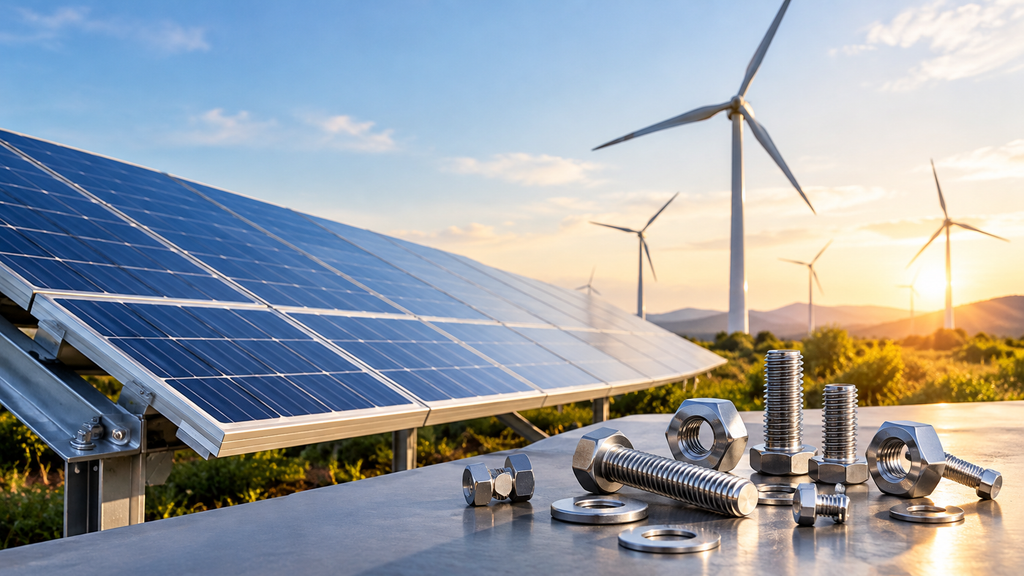
The rapid growth of solar and renewable energy projects is increasing the demand for reliable, durable, and corrosion-resistant components. While solar panels, inverters, mounting structures, and electrical systems receive most of the attention, fasteners play an equally important role in maintaining the strength, stability, and long-term performance of renewable energy installations.
From solar panel mounting systems to wind-energy structures and other renewable-energy infrastructure, fasteners are used to connect and secure critical components. Choosing the right fastener material, grade, size, and finish can help improve structural reliability and reduce maintenance requirements.
For project developers, EPC contractors, engineers, and procurement teams, understanding the role of industrial fasteners in renewable energy applications is therefore essential.
Why Are Fasteners Important in Renewable Energy Projects?
Renewable energy installations are often exposed to challenging environmental conditions. Solar installations may experience continuous sunlight, rain, humidity, dust, temperature fluctuations, and outdoor exposure. Wind-energy structures can experience vibration, changing loads, and demanding operating conditions.
Fasteners hold structural components together and help maintain the integrity of the overall assembly.
A suitable fastener should provide:
- Adequate mechanical strength
- Corrosion resistance
- Reliable clamping performance
- Dimensional accuracy
- Long-term durability
- Compatibility with the surrounding materials
- Resistance to environmental exposure
A fastener failure can affect the stability of a component or structure, making proper fastener selection an important part of renewable energy project planning.
Applications of Fasteners in Solar Energy Projects
Solar power installations use fasteners across different parts of the system. The exact requirements depend on the type of installation, structure, location, and environmental conditions.
1. Solar Panel Mounting Structures
Fasteners are widely used to secure solar panels to mounting structures. They can be used in connections involving rails, brackets, frames, clamps, supports, and other structural components.
Because many solar installations are located outdoors, corrosion resistance is an important consideration when selecting fastening components.
2. Solar Mounting Rails and Brackets
Mounting rails and brackets need secure connections to maintain the position of solar modules.
Fasteners used in these assemblies should be selected according to:
- Load requirements
- Material compatibility
- Installation environment
- Required strength
- Exposure to moisture and weather
3. Rooftop Solar Systems
Rooftop solar installations require fastening solutions for mounting structures and associated components.
Since rooftop systems remain exposed to weather for long periods, fasteners with appropriate corrosion resistance can help support long-term installation reliability.
4. Ground-Mounted Solar Projects
Large solar farms use extensive mounting structures and numerous fastening points.
For large-scale projects, procurement teams may need significant quantities of standardized fasteners. Consistency in dimensions, material, grade, and quality becomes particularly important for efficient installation and maintenance.
Role of Fasteners in Wind Energy Projects
Fasteners also have an important role in wind-energy infrastructure.
Wind turbines experience dynamic loads, vibration, and changing environmental conditions. High-strength fastening solutions may be required in structural and mechanical assemblies depending on the specific application.
Fasteners can be used in areas such as:
- Structural connections
- Equipment assemblies
- Tower-related components
- Machinery and mechanical systems
- Maintenance and replacement applications
The appropriate fastener grade and specification should always be selected according to engineering requirements and applicable standards.
Why Stainless Steel Fasteners Are Important for Renewable Energy
Corrosion is one of the major concerns for outdoor renewable energy installations.
Moisture, rain, humidity, industrial pollutants, coastal environments, and temperature variations can contribute to corrosion over time.
Stainless steel fasteners can provide an important advantage where corrosion resistance is required.
Common stainless steel grades include:
SS 202
SS 202 can be considered for applications where the environmental conditions and required performance make it appropriate.
SS 304
SS 304 is widely recognized for its combination of corrosion resistance, durability, and versatility. It can be suitable for many general industrial and outdoor applications.
SS 316
SS 316 provides enhanced corrosion resistance and can be particularly relevant for demanding environments, including applications exposed to chlorides or marine conditions.
The appropriate grade should be selected based on the project’s environmental conditions, engineering specifications, and required service life.
How to Choose the Right Fasteners for Solar Projects
Selecting a fastener should involve more than simply choosing the correct size.
1. Consider the Environment
Determine whether the installation is exposed to:
- Rain
- Humidity
- Coastal conditions
- Chemicals
- Dust
- High temperatures
- Temperature fluctuations
More aggressive environments may require higher corrosion resistance.
2. Select the Appropriate Material
Stainless steel and high-strength steel fasteners can serve different application requirements.
Material selection should be based on mechanical requirements, environmental exposure, compatibility, and project specifications.
3. Check the Required Strength
Structural and mechanical applications may require specific strength characteristics.
High-tensile grades such as 8.8, 10.9, and 12.9 are used for applications requiring higher mechanical strength, subject to the relevant engineering requirements.
4. Consider Material Compatibility
Fastener selection should account for the materials being joined. Material compatibility can help reduce corrosion-related problems and improve long-term performance.
5. Verify Dimensions and Specifications
Large renewable-energy projects often involve standardized components. Correct thread dimensions, diameter, length, grade, and other specifications are important for efficient installation.
6. Consider Long-Term Maintenance
Renewable energy installations are designed for long operating periods. Selecting suitable fasteners during the initial project stage can help reduce future maintenance and replacement requirements.
Benefits of Using Quality Industrial Fasteners in Renewable Energy
Using appropriate industrial fasteners can provide several benefits:
Improved Structural Reliability
Properly selected fasteners help maintain secure connections between components.
Corrosion Resistance
Suitable stainless steel fasteners can help withstand environmental exposure and reduce corrosion-related concerns.
Long-Term Durability
Quality fastening components can contribute to the service life of renewable energy assemblies.
Consistent Installation
Consistent dimensions and specifications can simplify installation, especially in large-scale projects.
Reduced Maintenance Requirements
Appropriate material and grade selection can help reduce premature fastening failures and unnecessary replacements.
The Future of Fasteners in Renewable Energy
As renewable energy capacity continues to expand, the demand for reliable fastening solutions is expected to remain important across solar, wind, and other renewable-energy applications.
Future projects are likely to place greater emphasis on:
- Corrosion-resistant materials
- High-strength fastening solutions
- Precision manufacturing
- Consistent quality
- Application-specific fasteners
- Efficient installation
- Long-term reliability
- Supply consistency for large projects
For manufacturers and suppliers, understanding these changing requirements is important for serving the renewable-energy sector effectively.
Why Choose a Reliable Industrial Fastener Manufacturer?
Renewable energy projects often involve large quantities of components and strict project specifications. Working with an experienced fastener manufacturer or supplier can help procurement teams source products according to required material, size, grade, and application.
A reliable supplier should be able to provide:
- Consistent product quality
- Multiple material and grade options
- Accurate dimensions
- Bulk supply capability
- Technical product information
- Customized solutions where required
- Reliable delivery
Viratra Fastners for Industrial Fastening Requirements
Viratra Fastners is a Vadodara-based industrial fastener manufacturer and supplier offering stainless steel and high-tensile fastening solutions for demanding industrial applications.
Its product portfolio includes bolts, nuts, washers, and other fastening solutions, with material and grade options including stainless steel and high-tensile grades.
For renewable energy, engineering, infrastructure, and other industrial projects, fastener selection should be based on the specific application, environmental conditions, material requirements, and engineering specifications.
Conclusion
Fasteners may be small components compared with solar panels, mounting structures, or wind turbines, but their role in renewable energy infrastructure is significant. They help maintain secure connections and structural integrity throughout an installation’s operating life.
As solar and renewable energy projects continue to expand, the demand for durable, corrosion-resistant, high-quality industrial fasteners will remain important.
Choosing the correct material, grade, dimensions, and specifications from the beginning can contribute to reliable installation performance and long-term maintenance efficiency.
For renewable energy projects, the right fastener is not simply a connecting component—it is an important part of the overall engineering solution.
Frequently Asked Questions
What type of fasteners are used in solar installations?
Solar installations can use different types of bolts, nuts, washers, clamps, and other fastening components depending on the mounting structure and engineering requirements. Stainless steel fasteners are often considered where corrosion resistance is important.
Why are stainless steel fasteners suitable for solar applications?
Stainless steel provides corrosion resistance and durability, making suitable grades useful for many outdoor applications. The correct grade should be selected according to environmental and engineering requirements.
Are high-tensile fasteners used in renewable energy projects?
High-tensile fasteners can be used in renewable energy applications where higher mechanical strength is required. Grades such as 8.8, 10.9, and 12.9 are available for different engineering requirements.
How do I select fasteners for a solar project?
Consider the installation environment, required strength, fastener material, dimensions, corrosion resistance, material compatibility, project specifications, and expected service conditions.
Why is corrosion resistance important in solar installations?
Solar installations are generally exposed to outdoor conditions such as rain, humidity, sunlight, and temperature variations. Corrosion-resistant fasteners can help maintain fastening performance over long-term exposure.